
What’s the Difference? (It’s not just the weight)
Rail transport plays a vital role in connecting communities, supporting economic growth and helping the global transition to greener travel. However, not all rail systems are the same. There are three core types of rail systems in use across the globe. Heavy Rail, Light Rail, and Very Light Rail (VLR) but what do they mean, and why does the difference matter?
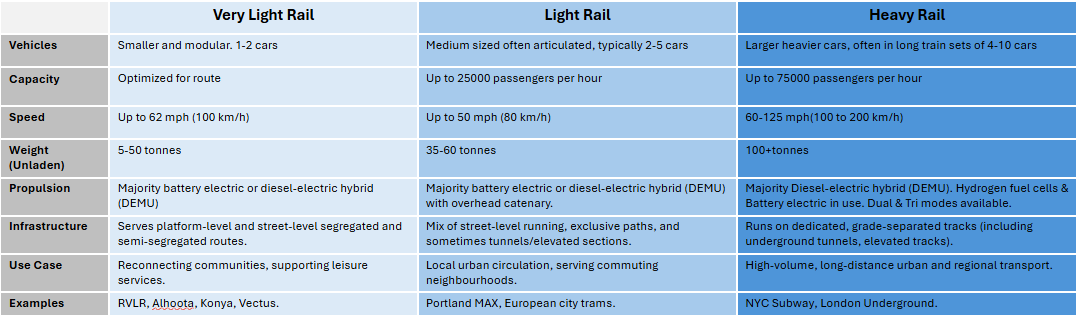
*figures provided based on examples and are subject to change
What is Heavy Rail?
Heavy rail refers to high-capacity, high-speed railway systems designed to carry large numbers of passengers or freight over longer distances. These systems typically operate on fully separated tracks, meaning they do not share road space with cars or pedestrians.
Heavy rail includes major metro systems, underground railways and mainline intercity routes. Because of their scale, they rely on significant infrastructure such as tunnels, bridges, and dedicated track corridors.
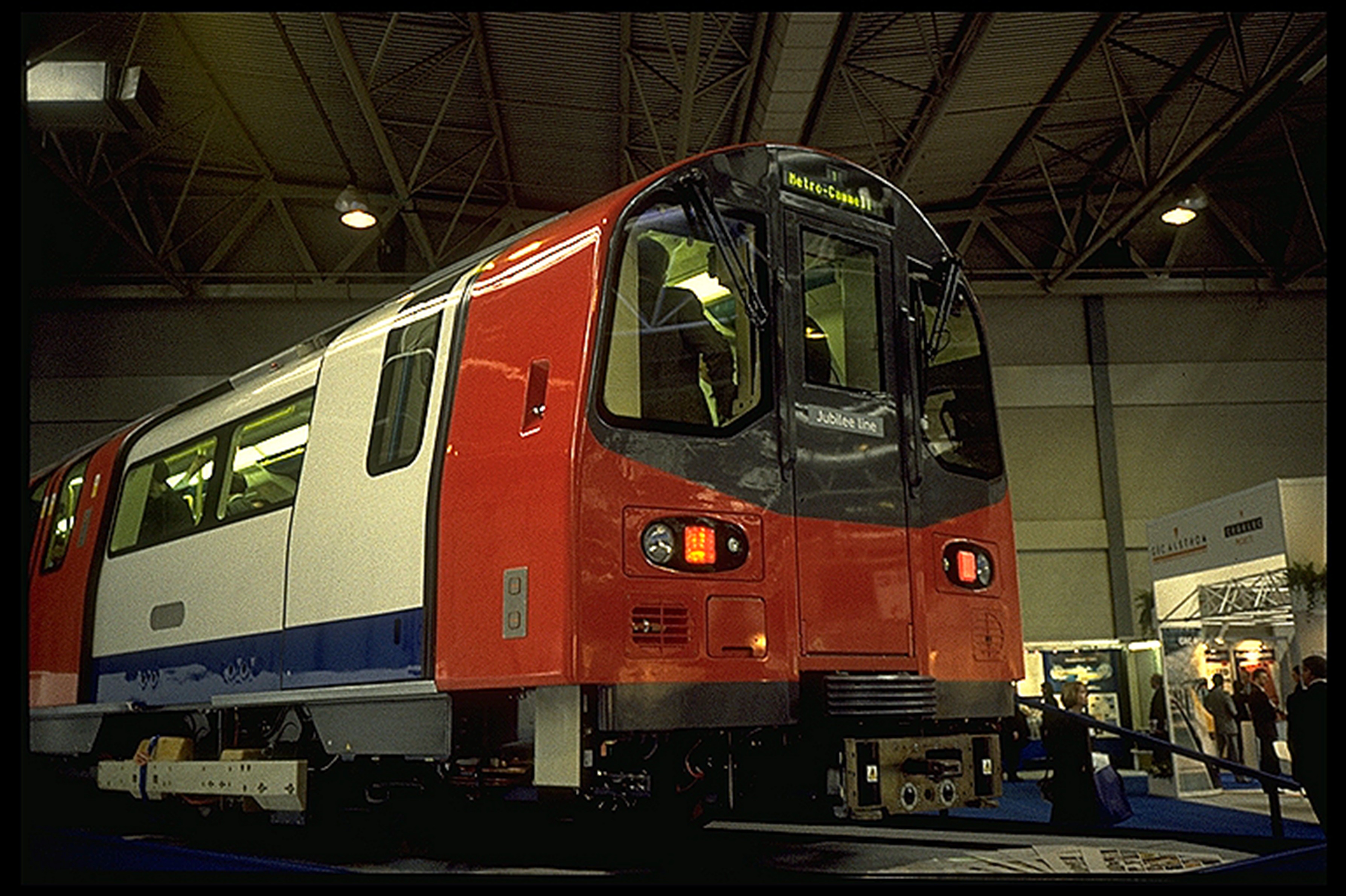
Heavy rail vehicle for London Underground
Key Characteristics of Heavy Rail
Heavy rail systems are built to move high volumes of people quickly and efficiently. Trains are larger, heavier, more powerful and usually made up of multiple carriages, allowing them to carry thousands of passengers. These systems often run at higher speeds and utlise overhead electrified lines or a third rail for power.
Examples of heavy rail systems include the London Underground, the New York City (NYC) Subway and national rail networks that support both passenger and freight services.
Heavy rail is extremely effective for high-volume areas and long-distance travel but requires major investment and long development times due to its infrastructure demands.
What is Light Rail?
Light Rail Transit (LRT) sits between heavy rail and smaller local transport solutions. It is commonly found in urban areas and is often referred to as trams or streetcars.
Light rail systems typically operate using overhead electric power and can run on a mix of dedicated tracks, shared road space and sometimes tunnels/elevated sections. They are designed to serve busy city corridors while providing frequent stops that connect neighbourhoods.
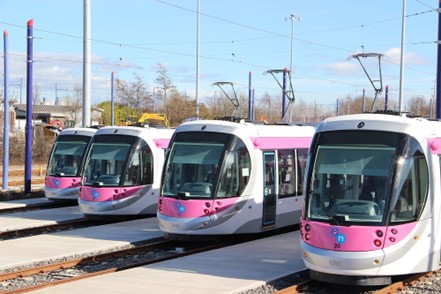
Light rail trams for Birmingham City Centre
Key Characteristics of Light Rail
Light rail vehicles are smaller and lighter than heavy rail trains, often operating as shorter, articulated cars. They offer medium passenger capacity and are designed with lighter, more flexible equipment, allowing it to navigate tighter turns and steeper gradients
However, light rail systems still require significant infrastructure investment. The weight of traditional (Light Rail Transit) LRT vehicles, which can exceed 40 tonnes, that significant civil engineering work is required to strengthen track foundations and support an LRT system.
Cities such as Birmingham, Manchester, and Edinburgh operate successful light rail networks that support urban circulation and reduce road congestion.
While highly effective in larger cities, LRT can be financially challenging for smaller towns and rural areas to implement.
What is Very Light Rail (VLR)?
Very Light Rail (VLR) represents the next step in rail innovation. Pioneered by Transport Design International (TDI), VLR is designed to deliver the benefits of rail travel in a more affordable, flexible and environmentally friendly way.
VLR vehicles use battery-powered, zero-emission propulsion systems and are significantly lighter than traditional light rail vehicles. Despite this reduced weight, they can still provide similar seating and standing space as any LRT vehicle.
Why VLR Is Different
Due to VLR vehicles being lighter, they place far less weight on infrastructure. This allows them to operate on existing or simplified track infrastructure, often avoiding the need for costly re-alignment of utilities.
As a result, VLR systems can be deployed quickly and with minimal environmental impact. This makes a more affordable and viable rail solution for reconnecting smaller towns, rural areas and communities.
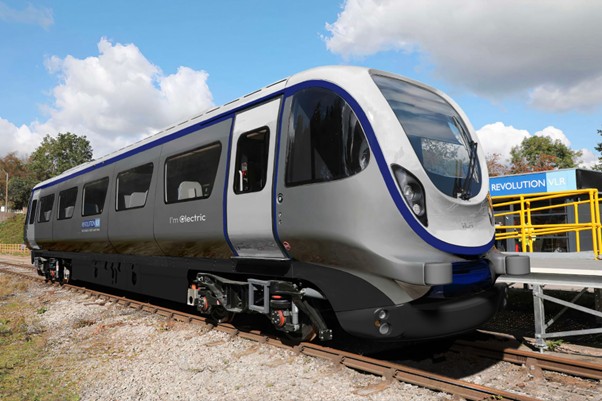
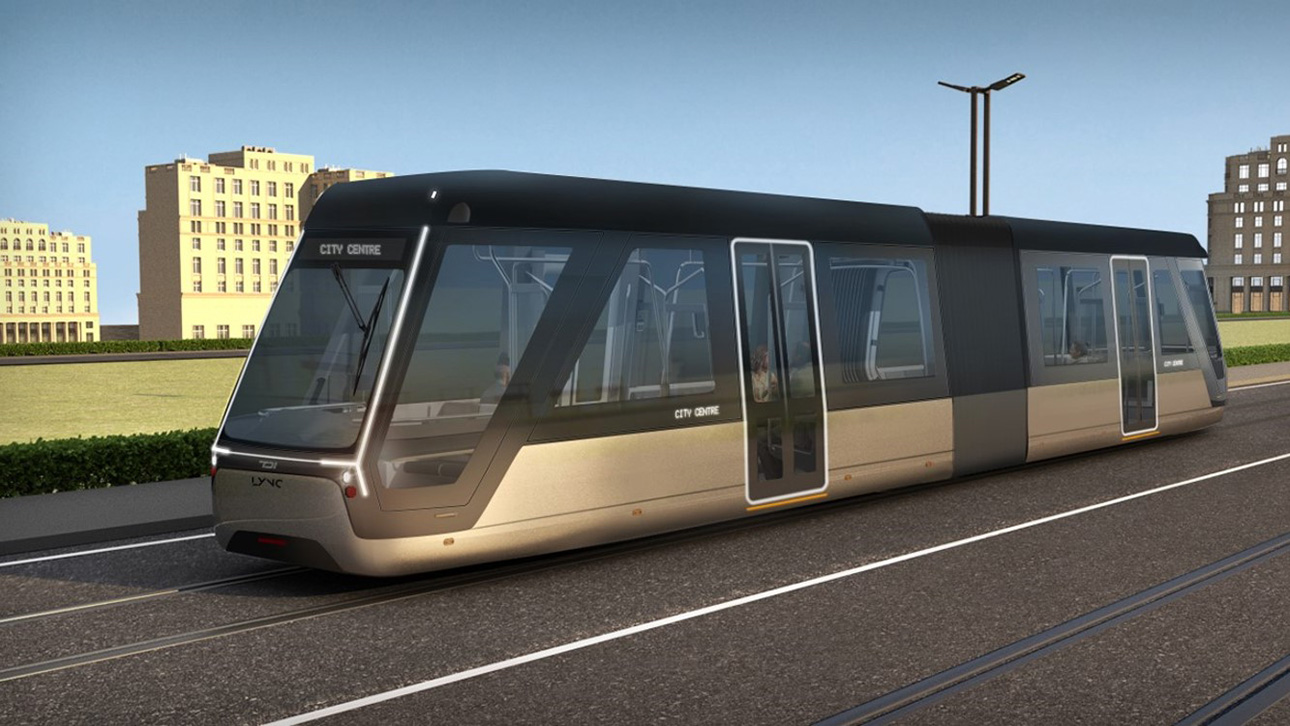
Model of our Revolution Very Light Rail vehicles
TDI’s Role in VLR Innovation
Our sister business Transport Design International is leading the way in Very Light Rail with award-winning solutions like the Revolution VLR (RVLR). This vehicle combines cutting-edge lightweight engineering and battery technology to transform the way rail systems are delivered.
RVLR is designed to operate on TDI’s VLR infrastructure, which enables rapid deployment with reduced disruption to local environments compared to traditional rail construction. With overall lower costs, VLR systems can help support regional economic growth, improve accessibility and strengthen community connections.
TDI continues to develop VLR solutions through projects including the Revolution VLR, Al Hoota VLR and Konya VLR alongside new VLR concepts and transport opportunities around the world.
Why Do We Need Different Rail Types?
Each rail system serves a unique purpose, and successful transport networks often rely on a combination of all three.
- Heavy rail provides high-capacity, long-distance connectivity between cities and regions.
- Light rail supports movement within major urban environments, linking key destinations.
- Very Light Rail (VLR)bridges the gap by offering an affordable and flexible solution for smaller communities and underserved areas.
Together, these systems help reduce traffic congestion and create integrated transport networks that improve accessibility while supporting sustainability goals.
The Future of Rail Transport
As cities grow and sustainability becomes increasingly important, transport solutions evolve. Very Light Rail offers a new opportunity to expand rail access into areas where traditional systems may not be practical or affordable.
We believe rail should be accessible, efficient and environmentally responsible. By combining innovation with proven rail expertise, VLR is helping shape the next generation of community focused transport.